

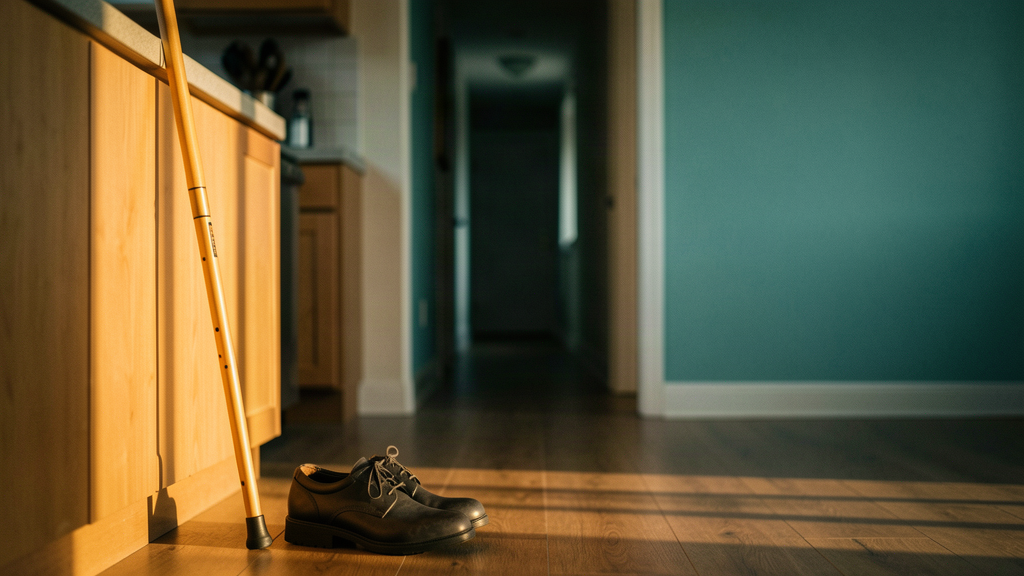
The fall gets all the attention. The weeks afterward are what decide the rest of your year. The quiet injury is not the wrist you landed on. It is the decision you make a few days later, almost without noticing: you stop taking the stairs, you stop walking to the mailbox, you stop going out alone.
It does not feel like a decision. It feels like common sense. You fell, it hurt, and your body is telling you to be careful. Being careful is not the problem. The problem is that caution keeps its own books, and the balance it protects against is the balance you lose by sitting still.
This site has built a fall library: the three balance tests, the room-by-room home walkthrough, the medication check, the habits that keep you on your feet. Every one of them is about preventing a fall. This one is about the thing that happens after one.
Falls Prevention Awareness Week runs September 21 to 25, and the theme this year is “From Awareness to Action.” Most of us know what to do about falls. The action part is harder, and it is harder still after a scare.
The Loop, Named
Here is what the research calls it: fear of falling, and the activity restriction that follows it. Two ordinary things that take turns feeding each other.
It starts with a fall, or a near-miss, or sometimes with no fall at all. You become more careful. You skip the uneven path and take the car. You stop reaching for the top shelf, and you stop walking to the corner in the evening. Each choice is small and sensible on its own. Together they shrink your world a few feet at a time.
The muscles and reflexes that keep you upright are trained by using them. Stop using them and they fade, which makes the world a little more frightening, which makes staying home a little easier. That is the loop.
This is not a character flaw and it is not a sign that you are giving up. It is a documented pattern. In one twelve-month study of 543 older adults who were not yet limiting their lives, 10.1 percent had started restricting daily activity over concerns about falling by the end of the year. The predictors were frailty, a fall during that year, and a slower walking test. The fear did not arrive out of nowhere: a real change in the body came first, and the worry grew up around it.
What the restriction costs is steeper than most people expect. In a three-year study that separated out who was limiting activity specifically because of fear of falling, the people avoiding three or more activities had worse lower-body performance and were more likely to lose independence in daily tasks, even after accounting for how they were doing at the start. The fear is not a mood. It shows up in the body, and on the calendar.
Why the Fear Outlives the Bruise
The fear itself is not the enemy. It is your brain doing its job, and a certain amount of it is useful: if you have a real risk of falling, a little caution is sensible.
The trouble starts when the concern is bigger than the risk. Researchers in Sydney followed 500 people aged 70 to 90 for a year, measuring both their actual physical fall risk and how worried they were. Both predicted who would fall. The group with low physical risk but high concern fell more often than the group with low risk and low concern. Walking around frightened of falling is itself a thing that makes falls more likely, mostly through what fright does to your attention, your stride and your willingness to go out.
Here is the part that should be better known. In the same body of work, researchers checked whether lowering the fear could backfire by making people overconfident, and concluded it would not. Taking fear down a notch does not turn a careful person into a reckless one. You are not choosing between scared and sensible and confident and careless. There is a third place to stand, where you know your risk, work on it, and go out anyway.
So the goal is not fearlessness. It is proportion.
What the Evidence Says About Getting It Back
Two kinds of help exist, and they work on different halves of the loop.
The first is exercise, and here the evidence is real but modest. A Cochrane review pooled 30 trials with 2,878 participants and found that exercise reduces fear of falling by a small to moderate amount right after a program ends. The caveats come with it: the trials were not high quality, and most did not check whether the benefit lasted once the program stopped. The confidence comes from continuing, not from graduating.
The second is newer and, in the studies, more dramatic. In a 2026 randomized trial published in Scientific Reports, 44 adults aged 60 to 75 were assigned either to eight weeks of supervised balance and coordination training, three sessions a week, or to carry on as usual. The training group’s measures of fear of falling dropped by 42 percent. Static balance errors fell by 58 to 74 percent, walking speed rose by 28 percent, and most of the gains were still there two months later. Keep the size in mind: small, supervised, and measured in a lab. Still, it says something encouraging about how quickly a body responds.
There is a third kind of help, and it may be the most useful thing here: classes built specifically for this loop. The best known is A Matter of Balance, developed at Boston University and now run in communities across the country, usually in eight two-hour sessions, often taught by trained volunteers rather than medical staff. Its two stated goals are the two halves of this article - reduce fear of falling, and increase activity. Participants report more confidence in managing falls and more activity afterward. One note: the strongest results are on confidence and self-reported activity, and not every study finds large gains in measured activity. That does not make the class a waste. It makes it a start, and a place to meet other people doing the same work. Ask your Area Agency on Aging, your senior center, or dial 211 about what runs near you.
Underneath all of it, ask for a physical therapist. This is what they do all day, and a supervised balance program can be built around your knees and your kitchen counter. Ask your doctor for a referral, and ask whether your walk, your medications, your vision or your feet are adding to the risk - because fear often settles on top of a real, fixable risk factor, and fixing that is the fastest way to feel steadier.
The Way Back Is Graded
Confidence does not come back from a decision. It comes back from evidence, one small demonstration at a time. That is the same lesson our piece on avoidance makes about everything else in life - the hard thing you skip is the thing doing the teaching - and it applies to the body exactly as it applies to an unopened envelope.
So:
Name the outing you stopped taking. Not every activity. The one. The evening walk, the grocery store, the stairs, the church basement. Writing it down turns a fog of worry into one specific thing.
Make a version of it that is almost too small. Not the old distance. Five minutes. One flight down and back up, hand on the rail, when nobody is waiting behind you. If the first version feels a little unsatisfying, it is the right size.
Keep a support within reach. A counter, a wall, a rail, a cane, a friend’s arm. Supported practice is still practice, and it is how the frightening version gets re-filed as an ordinary one.
Repeat the same small thing a few times. Same route, same time of day, so you can feel the fear drop as the place becomes familiar.
Take someone the first time. Not because you need them, but because a witness turns a private worry into a shared plan, and gets you out the door on the day you would have talked yourself out of it.
Then extend it, slowly, in whatever direction you want. A little farther, a little longer, a little less support.
And notice what the log says. Almost every time, the real cost of the outing is milder than the price your head quoted you. That is the interest you were paying in advance, and this is how you stop paying it.
When the Fear Needs a Doctor’s Help
Some of this is yours to work on. Some of it is a symptom, and worth a professional’s eyes.
Go and get seen if the fall was unexplained, or if you are dizzy or lightheaded, tripping more than you used to, or weaker on one side, or if your feet hurt badly enough that you are changing how you walk. Go sooner if the fear is keeping you inside, or if your mood has been sinking along with your activity - worry and low mood travel together often, and both respond to help.
At that visit, be specific. Ask for a balance and walking assessment, a medication review (several common drug classes quietly raise fall risk), a vision and hearing check, and a referral to physical therapy. If your community has a falls clinic or a falls prevention program, ask about it by name. Nobody will be surprised by the question, and most of this is covered when it is medically necessary.
One more thing: do not let anyone, including yourself, decide that the careful years are over. A cane is a tool. Staying home is not a treatment, and it is not safer in the long run.
What to Do Now
- Write down the one thing you stopped doing. One line, on paper, today.
- Do the five-minute version of it this week. With a counter, a wall or a friend within reach.
- Ask your doctor for a balance assessment and a physical therapy referral at your next visit.
- Find out what runs near you. Call 211 or your Area Agency on Aging and ask about A Matter of Balance or another evidence-based falls class.
- Keep the scoreboard going. The three one-minute balance tests tell you whether the work is taking.
- Tell one person what you are working back toward. It is harder to quietly give up on something you said out loud.
A fall is an event. The shrinking is a choice that gets made for you a hundred small times unless you make it consciously instead. You do not have to feel brave to start. You only have to walk to the mailbox.
If the fear has been with you a while, start with the gentlest on-ramps on this site: getting up when you are down and four minutes a day.
Disclaimer: I am not a doctor or a physical therapist. I am a grandmother who has had to learn this the way most of us do - after a scare, not before it. Check with your doctor before starting anything new, especially if you have had a fall you cannot explain, if you take medicine that makes you dizzy, or if you have a heart or balance condition.
If this helped, there is more where it came from. The Basic Hub sends one practical guide a week - no spam, no jargon. Sign up below so the next one finds you.